Building date: Demolished about 1915
Original use:
Corner structures:
Mortar application and content:
Types and uses of stones:
Types and choice of windows:
Structures with similar masonry details:
Masons who worked on building:
Unique features:
Map views courtesy Google Maps . Current information does not provide the exact location of the structure. It is stated to have been at the end of of Jay Street on the north side of Lake Road adjacent to the shore of Lake Ontario in Putltneyville: 43°16'54.213"N 77°10'51.58"W.
Town of Williamson and Wayne County Maps.
Russell Cole's blacksmith shop at the end of Jay Street in 1902. That area has long since eroded away into Lake Ontario. Richard Palmer blog.
Russell Cole Blacksmith Shop history sheet. From the personal research of cobblestone historian Karen Crandall.
Former Blacksmith Shop - north side of Lake Road/opposite Jay St., hamlet of Pultneyville/town of Williamson, Wayne Co. - a 2-1/2-story, gable-roof building right at the edge of Lake Ontario shore line; it was photographed in the early 20th century by May Bragdon, sister of renowned Rochester architect Claude Bragdon/the photo is featured in May's scrapbooks, which have been digitized & are on-line at the University of Rochester's Rush Rhees Library/special collections web site (https://maybragdon.lib.rochester.edu/). The building collapsed into the lake, and there is no surviving physical evidence of it - even the foundations are gone (per info from Chip Stevens, retired architect/Pultneyville native, who knows extensive info about this hamlet's architecture & history). Cynthia Howk email 6/30/2020
This venerable structure, the cobblestone blacksmith shop, stood with its back to the lake directly opposite the foot of Jay Street. Aaron Brewer was the blacksmith before the turn of the century, and the anvil continued to ring under at least two of his able successors until about 1915. This was a popular gathering place for men and boys.
Wil-24 Cole Blacksmith Shop Text DSC_1021.jpg Undated photograph.
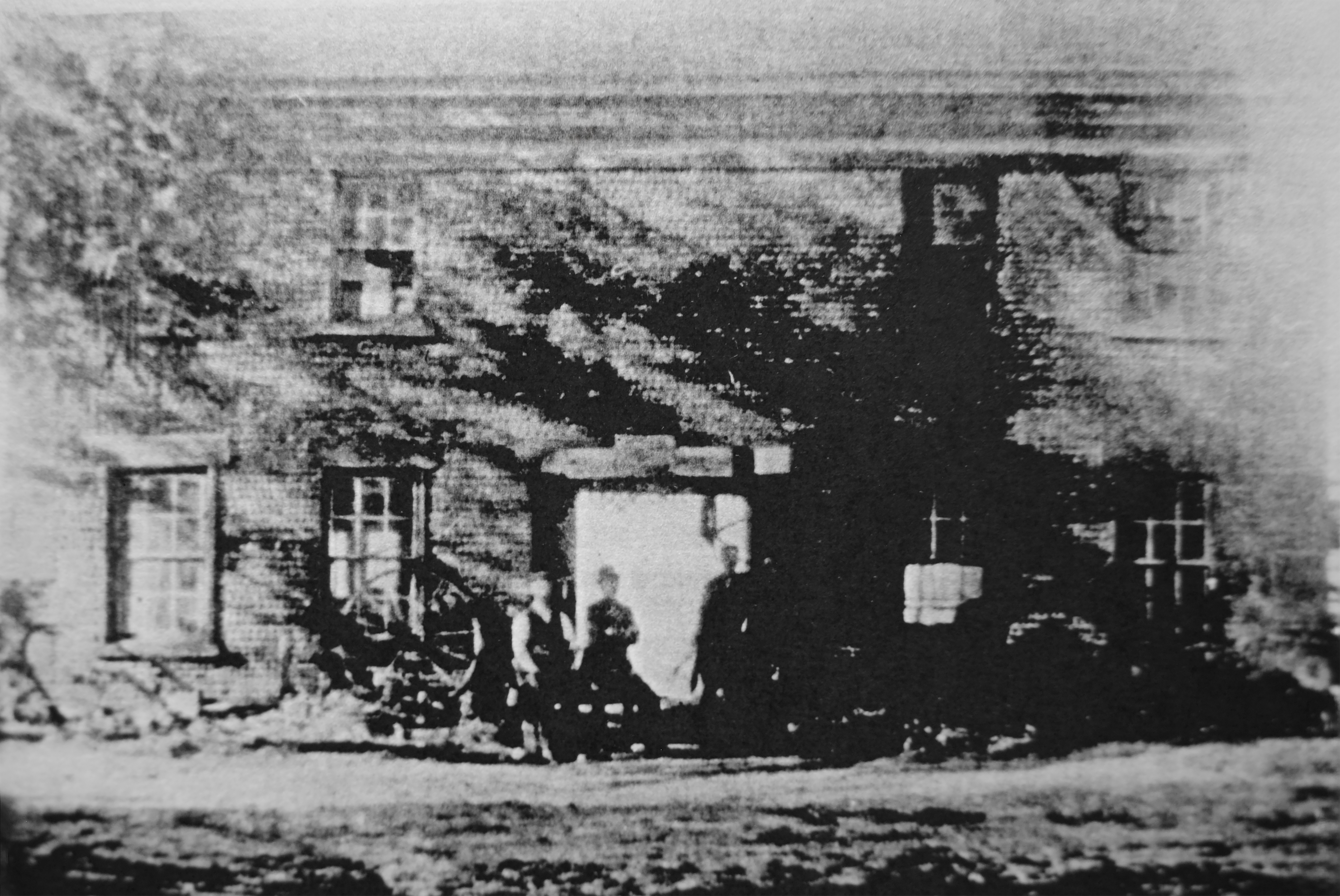
Cynthia Howk took this photo of the [album photograph and] typed caption that appears under the photo from the family photo albums owned by Chip Stevens. Sadly, the original photo albums and all the images they contained were destroyed some years ago by Fred Cornwall's second wife, who, from family information, was a vindictive person not interested in preserving any family memorabilia. Fortunately, prior to the albums destruction, Chip Stevens had the opportunity to make xerox copies of all the pages/photos in the two albums. These xerox copies are now the only known surviving copies of dozens of outstanding photos showing rural, agricultural life in Pultneyville at the beginning of the 20th century. Cynthia Howk email 7/4/2024.
Editor's Note: The photograph is a "best effort" restoration that is likely the 5th generation image of the original negative - likely poor quality (1), photographic print in original album (2), xerography copy (3), Cynthia's digital camera image file (4), and my digital restoration effort in Photoshop (5). Understandably, there is little left of the original scene to view, but is still included as part of the historical record of this long gone cobblestone structure.
Brothers Aaron and Cornelius Brewer operated this blacksmith shop at the foot of Jay Street and employed three to four men. Brewer lived at the corner of Washington and Jay streets in Pultneyville. His blacksmith shop was across from his home. He later sold out and moved to a farm near East Williamson. He committed suicide on March 14, 1899 at the age of 70. He adjusted a rope around his neck and then shot himself in the head with a revolver.
The point of land where the shop stood was gradually worn away by the action of the waves, until the water began to undermine the foundations of the building. As a result it cracked and sagged and finally had to be demolished. David Benedict was the last blacksmith to use the building. There was space enough between the building and the lake for a roadway for a team of horses. There was an outside flight of steps on the east side of the building.
Old timers recalled the big mill stone in the front yard, where the blacksmith would lay a wagon wheel, while he hammered the red hot iron tire into position on the felly, after heating it in the forge. The ringing of the strokes against the iron tires was as much of the sounds of the village as the pounding waves of the lake and rattling of anchor chains of ships.
This old mill stone originally came from the grist mill which stood near the bridge in Pultneyville. Later it was on the terrace of the former of a house at the corner of Jay and Washington streets. Richard Palmer email 7/6/2020
Editor's Note: There is a contradiction about the name of the blacksmith who owned the structure in 1902. An "Editorial Note" in the May Bragdon Diaries collection at the University of Rochester's Rush Rhees Library states "Cobblestone building identified in 2018 as Russell Cole's Blacksmith shop. No longer standing, it was at the end of Jay Street in Pultneyville." Richard Palmer states in a 7/6/2020 email "Aaron Brewer's blacksmith shop at the end of Jay Street in 1902."
This structure is not listed in the Wayne Historians Organization (WHO), Historic Sites Inventory Website
 1853 Wayne County Wil-24 Excerpt Map.jpg ¹ |  Wil-24 Cole Blacksmith Shop 1.jpg ² 1872 |  Williamson - Jay St., Pultneyville, 1902 - Russell Cole blacksmih shop.jpg ³ 1902. Award-winning Pultneyville artist/retired architect Roland ("Chip") Stevens III painted the blacksmith shop based on this photograph. |  IMG-3171.jpg 4 |
 ABrewerBksmithParkSign1.jpg 5 |
¹ 1853 Map of Wayne County courtesy Library of Congress. Editor's Note: The structure was located in the highlighted area of the map, but there is no annotation for a blacksmith shop. Most references to-date state the location as the end of Jay Street. Maps do not show an extension of Jay Street beyond Lake Road; therefore, the address could have been Lake Road.
² Image courtesy Cobblestone Museum. Photograph provided by Chester A. Peters. Revised text of hand written notation on reverse: Copy of very poor 1872 original photograph. Blacksmith Shop shown at far left on lake front at the end of Jay Street. Long building at left center is Warehouse (Lyons). Custom House high barn (Sessions House) at right center. Chester A. Peters, former Williamson Town Historian.
³ Image courtesy Richard Palmer. Attribution - Photograph by May Bragdon, from diary, January 19, 1902 - February 4, 1904, page 17, 5/17/1902.
4 Aaron Brewer's Blacksmith Shop at the end of Jay St. on the lake. Chester A. Peters, former Town of Williamson Historian.
5 Image courtesy Perry Howland, Williamstown Town Historian. Richard Palmer email 200705.
